Askiitians Tutor Team
Last Activity: 5 Months ago
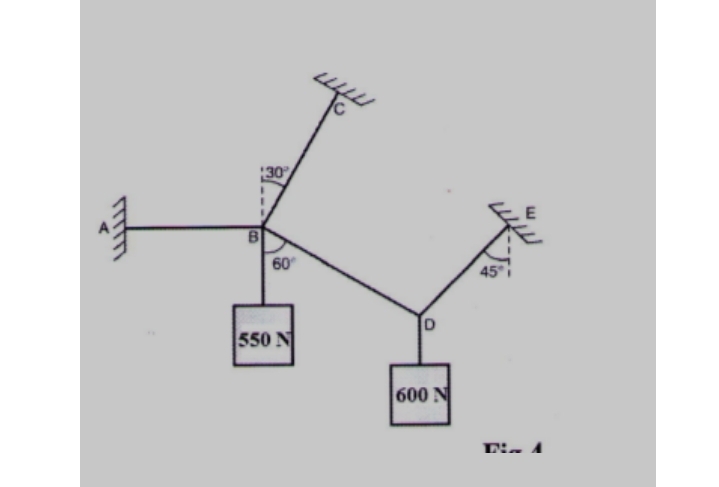
To determine the tensions in the various segments of the cable supporting the loads at points B and D, we need to analyze the system using principles of static equilibrium. In a static system, the sum of forces and the sum of moments acting on the system must equal zero. Let's break down the problem step by step.
Understanding the Setup
We have a system of cables supporting two loads:
- Load at point B: (500 + R) N
- Load at point D: (600 + R) N
Here, R represents an additional force that may vary. The cables are connected in such a way that they form a network, and we need to find the tension in each segment of the cable.
Applying Static Equilibrium
For the system to be in equilibrium, the following conditions must be satisfied:
- The sum of vertical forces must equal zero.
- The sum of horizontal forces must equal zero.
- The sum of moments about any point must equal zero.
Step 1: Identify Forces
Let’s denote the tensions in the cables as follows:
- T1: Tension in the cable segment supporting load B
- T2: Tension in the cable segment supporting load D
- T3: Tension in the connecting cable between the two loads
Step 2: Set Up Equations
We can set up our equations based on the forces acting on the system. For vertical forces, we have:
Sum of vertical forces:
T1 + T3 = (500 + R) + (600 + R)
This simplifies to:
T1 + T3 = 1100 + 2R
For horizontal forces, if we assume the system is symmetric and the angles are equal, we can express T2 in terms of T1 and T3. However, without specific angles, we can only express relationships between the tensions.
Step 3: Solve the Equations
To find the tensions, we need additional information, such as the angles at which the cables are positioned or the lengths of the segments. Assuming we have that information, we can use trigonometric relationships to express T1, T2, and T3 in terms of known quantities.
Example Calculation
Let’s assume the angles are such that:
- Angle for T1 is θ1
- Angle for T2 is θ2
Using trigonometry, we can express the tensions as:
T1 = (500 + R) / sin(θ1)
T2 = (600 + R) / sin(θ2)
And we can relate T3 to T1 and T2 based on the geometry of the setup.
Final Thoughts
Once we have the angles and any additional information, we can substitute back into our equations to find the specific values for T1, T2, and T3. Remember, the key to solving these types of problems is to carefully analyze the forces and apply the conditions of static equilibrium accurately. If you have any specific values for R or the angles, we can go through the calculations together!