
How to calculate total no of possible enantiomers and disastomers

Aman Deep Singh , 16 Years ago
Grade 12
 Organic Chemistry> Enantiomers...
 3 Answers
Hi
Diastereomers (or diastereoisomers) are stereoisomers that are not enantiomers (non-superimposable mirror images of each other). Diastereomers can have different physical properties and different reactivity. In another definition diastereomers are pairs of isomers that have opposite configurations at one or more of the chiral centers but are not mirror images of each other
In simpler terms two stereoisomers are said to be diastereoisomers if they are not mirror images of each other and one or more stereogenic centers differ between the two stereoisomers. According to this same definition, cis-trans isomerism is a form of diastereomerism.
If a molecule contains a single asymmetric carbon atom or stereocenter, it will form two mirror images. If a molecule contains two asymmetric carbons, there are up to 4 possible configurations, and they cannot all be mirror images of each other. The possibilities continue to multiply as there are more asymmetric centers in a molecule. In general, the number of diastereomers of a molecule can be determined by calculating 2n, where n=the number of chiral centers in the molecule. This holds true except in cases where the molecule has meso forms.
Therefore the total no. of enantiomers are the total no. of Stereoisomers minus the no. of diastereomers.
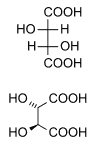
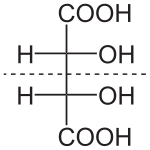
Tartaric acid contains two asymmetric centers, but two of the "isomers" are equivalent and together are called a meso compound. This configuration is not optically active, while the remaining two isomers are D- and L- mirror images, i.e., enantiomers. The meso form is a diastereomer of the other forms.
|
|
 |
 |
|
(natural) tartaric acid |
D-(-)-tartaric acid |
mesotartaric acid |
|
(1:1) |
||
Dear student,
If a molecule contains a single asymmetric carbon atom or stereocenter, it will form two mirror images. If a molecule contains two asymmetric carbons, there are up to 4 possible configurations, and they cannot all be mirror images of each other. The possibilities continue to multiply as there are more asymmetric centers in a molecule. In general, the number of diastereomers of a molecule can be determined by calculating 2n, where n=the number of chiral centers in the molecule. This holds true except in cases where the molecule has meso forms.
Please feel free to ask your queries here. We are all IITians and here to help you in your IIT JEE preparation.
All the best.
Win exciting gifts by answering the questions on Discussion Forum. So help discuss any query on askiitians forum and become an Elite Expert League askiitian.
Now you score 5+15 POINTS by uploading your Pic and Downloading the Askiitians Toolbar respectively : Click here to download the toolbar..
Askiitians Expert
Sagar Singh
B.Tech, IIT Delhi

Prepraring for the competition made easy just by live online class.

Full Live Access

Study Material

Live Doubts Solving

Daily Class Assignments

Last Activity: 3 Years ago
Last Activity: 3 Years ago
Last Activity: 3 Years ago
Last Activity: 3 Years ago
