Preparation Tips for Organic Chemistry - CBSE Class 12
Table of Content |

Chemistry being one of the high scoring and difficult subject for many students, it is very much essential to focus on some of the smart ways to ace the subject. Organic chemistry is one of the major parts of the chemistry and most of the questions are from this part only. Here we are presenting you some of the very important tips and tricks to master the Organic Chemistry for CBSE Class 12 board exam.
Let’s first get through the syllabus and portion for CBSE class 12 Organic Chemistry
CBSE Class12 Syllabus For Organic Chemistry
-
Haloalkanes and Haloarenes
-
Alcohols, Phenols and Ethers
-
Aldehydes, Ketones and Carboxylic Acids
-
Biomolecules
-
Polymers
-
Chemistry in Everyday Life
Click here for CBSE Class 12 Syllabus
Marks Distribution
The organic chemistry contributes to approx 28 marks in the CBSE Class 12 Chemistry paper. The chart below shows the mark distribution as per the important topics of the Organic Chemistry which have been asked in the previous year examinations.
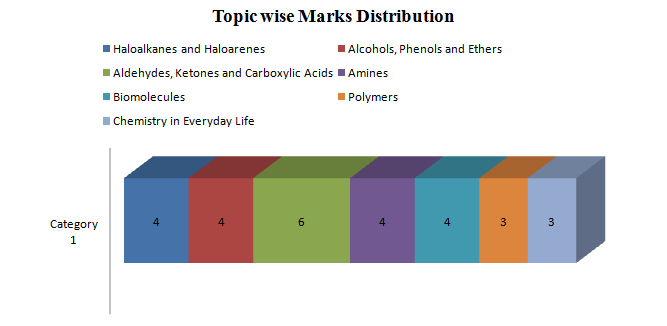
Clcik here for Organic Chemistry Study Material
Expected Portions from which the Organic Chemistry of CBSE Class 12 Board Exam Paper can be Framed
Books to Refer for Preparing Organic Chemistry
-
Organic chemistry - OP Tandon
-
Chemical numerical by Mukherjee
-
NCERT book for class 12 Chemistry
Some Important Terminologies Used In Organic Chemistry

-
Central Atom or Ion - The ion or atom with which a fixed number of ions or groups are bound in a proper geometrical arrangement in a coordination entity around it
-
Ligands - Ions or molecules bound to the central metal atom or ion in a coordination entity
-
Coordination Sphere- The central atom or ion and the ligands attached to it are enclosed in square brackets, are collectively called coordination spheres.
-
Coordination Number- Number of ligand-donor atoms that are bonded directly to the metal
-
Coordination Polyhedron- The ligand atoms arrangement in spatial form which are directly attached with central atom or ion
-
Oxidation Number of Central Atom- The charge an atom can carry if all the ligands are removed along with the electron pairs that are shared with the central atom
-
Coordination Compounds − Complex compounds in which the transition metal atoms are bound to a number of anions or neutral molecules
Tips to Prepare Some of the Important topics of Organic Chemistry

IUPAC Nomenclature questions: As per the last year question papers of Chemistry CBSE class 12 the portion of organic chemistry had its major part from the tables of common and IUPAC names as given in the NCERT book. It is always advised to go thoroughly through it to have a clear basic idea of the subject core.
Distinction test: The distinction test are commonly asked in between the aromatic and aliphatic compounds, compounds with two different functional groups, compounds with same functional group but with different atoms arrangement
-
Always check the marks for the questions, if the question carries one mark, it is required to show only one test.
-
Make sure you prepare the structural formulae of the compounds that can be used here.
-
Memorize the reactions of the substances and the difference of the structures as well.
-
Apply the reactions by keeping the skeletal structure in mind and its difference
Name reactions: List down the important name reactions which have been asked in the past year question papers. Some of the important ones which have been asked repeatedly are: Williamson synthesis, Aldol Condensation, Coupling reaction, Sandmeyer reaction, Kolbe’s reaction, Hoffmann Bromamide, Cannizzaro Reaction, Clemmensen Reduction reaction etc.
Conversions: Questions on conversions are always important and are the most expected ones. There are several ways to solve these sorts of questions but you need to know the most feasible and the shortest way of solving it. You must also know that CBSE board has never asked to mention the conversions having more than 3-steps.
-
Practice the questions related to conversion and while preparing write down the starting compound and final compound can make your process of solving the question very easy.
-
Note down the structural differences as it mostly differs in the functional groups, carbon atoms or may be both
-
Memorize the reactions properly as these can be used to solve these Conversion questions
You might also Like to Refer
How to prepare for CBSE Class 12 Physics
How to prepare for CBSE Class 12 Maths
View courses by askIITians


Design classes One-on-One in your own way with Top IITians/Medical Professionals
Click Here Know More

Complete Self Study Package designed by Industry Leading Experts
Click Here Know More

Live 1-1 coding classes to unleash the Creator in your Child
Click Here Know More